Recent euthanasia case has caused mass controversy and debate leading up to the general elections – Jon Kuch

Spanish protesters arrive outside of a Madrid court in support of euthanasia, after a 70 year old man was arrested for helping his terminally-ill wife end her life (The Telegraph).

After giving a lethal drug dose to his terminally-ill wife, Ángel Hernández confessed and spent the following night in police custody. It was no act of murder however, as his wife
María José Carrasco suffered from multiple sclerosis and voluntarily took the dosage to end her own life.

Ángel Hernández welcomed the uproar that he knew this would cause

Moments before a lethal dose of sodium pentobarbital was taken by Carrasco, the married couple recorded a video to demonstrate that it was her own wish to end her life. Immediately after, Hernández turned himself over to the police, hoping to “shine a light on this issue.” Despite his openness to and respect for the law, Hernández believes that the law regarding euthanasia “should have been resolved a long time ago.”
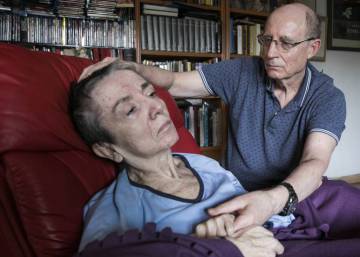
Ángel Hernández and María Carrasco record a video of Carrasco’s last moments to prove that euthanasia was her own decision.

This act of euthanasia has stirred up mass debate among Spanish citizens

Controversy has arose on the Spanish streets of Madrid as protesters take to the street in support of Hernández. With various signs and banners, it’s clear what the message is: legalize euthanasia. If Spain were to do so, it would become the fourth country to fully legalize euthanasia, behind Luxembourg, Belgium, and the Netherlands.

With elections quickly approaching, a euthanasia debate takes the stage

Spanish general elections are going to be held on April 28, and with many spots up for grabs, candidates are doing everything they can for their voices to be heard. Current Prime Minister and Socialist Party (PSOE) leader Pedro Sánchez promised to legalize euthanasia if he wins a parliamentary majority. However, the current majority party Ciudadanos (Citizens) and the right-wing People’s Party (PP) seem to oppose its legalization, and have been blamed for blocking a bill aimed at this debate. The fate of this legislation may in turn be decided by the outcome of the upcoming election.
Jack Williams – Rejection Hurts, Especially When it is From a King

In my experience, it’s hard to fault someone for asking for an apology. After all, telling someone that they shouldn’t be offended usually makes you seem more offensive. Although, I say this as someone who has never been asked to apologize for the massacre of thousands of people. Mexico’s new president, Andres Manuel, recently demanded an apology from Spain’s King Felipe VI and Pope Francis for Spain’s conquest over the indigenous peoples of Mexico 500 years ago. This request has divided Spain’s political parties and left many people wondering: is now the time to tell someone that they shouldn’t be offended?

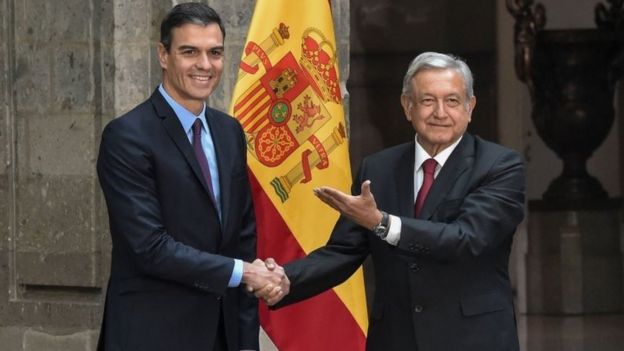
In this file photo taken on January 30, 2019 Mexico's President Andres Manuel Lopez Obrador (R) welcomes Spain's Prime Minister Pedro Sánchez at the National Palace in Mexico City.
Spanish Prime Minister Pedro Sánchez visiting Mexico in January

Spain’s Government Rejected Mexico’s Request

As Mexico’s first leftist president in seventy years, Manuel believes that Mexico will not be able to fully reconcile with Spain until an apology has been given, but Spain refuses to respond to Manuel’s demands. The Spanish government answered Mexico by saying, “The arrival, 500 years ago, of Spaniards to present Mexican territory cannot be judged in the light of contemporary considerations.”

This response did not sit well with left-wing Spanish politicians. The left-sided political party, Podemos, said that they will give Mexico a formal apology and offer additional forms of restoration to Mexico if elected. On the opposite end of the spectrum, right-wing Spanish politicians agreed with the government’s response. Conservative leaders went as far as to say that Manuel’s demands are an “intolerable offense to the Spanish people.” Overall, I think this political divide makes sense given Erin Meyer’s cultural dimensions. Since Spain sits in the middle of the collectivist and individualistic dimensions, it’s understandable that their political parties would have different approaches to harmony and responsibility.

Recognizing Commonalities Gave Me a New Perspective

I think this story matters for an understanding of Spain because their historical conquests are a significant part of their history. To an extent, this story actually changed the way I view Spain. Prior to reading this, Spain felt very hard to relate to since all I have been hearing about are the stark cultural differences between the US and Spain. This article shows that there are historical similarities between our countries that bond us. In a similar vein, the same type of apology could be demanded from Native Americans and would likely generate a similar response. By reading this, I think I will spend more time in Spain looking for ways we are similar and spend less time caught up in all the ways we are different.


Sultana Zannah- Spain has experienced multiple cases of euthanasia, which has led to the fight for its legalization.

Citizens of Spain protesting for the legalization of euthanasia

According to a survey published by La Vanguardia, 84 percent of Spaniards believe that euthanasia should be an option for terminally ill patients who have the mental capabilities of making that choice. This number was largely due to the influence of multiple heart-breaking stories about euthanasia in Spain.

Debates on euthanasia has been sparked after a man confessed to assisting in the death of his wife.

Ángel Hernándezwas arrested after he helped his wife swallow a deadly substance which ended her life. His wife, Maria José Carrasco, has been suffering for 3 decades from multiple sclerosis.Ángel Hernández released a video of his last conversation with his wife, and that sparked a political debate in Spain over the legalization of euthanasia.

Spain’s socialist government proposed a bill to make euthanasia legal, which other political parties, except the People’s Party (PP) have agreed to support. Additionally, religious leaders oppose the legalization of assisted suicide. 

Hofstede’s cultural dimension shows that Spain has a more collective culture than other countries like the US, and offers less personal freedom. The legalization of euthanasia will help decrease the degree of collectivism in Spain, and will give the citizens personal freedom to decide whether to live or end their pain.

Ramon Sampedro’s death caused a huge debate on the legalization of euthanasia in Spain, a largely Catholic country.

Ángel Hernández’sstory isn’t the first to spark a debate over euthanasia in Spain.Ramon Sampedro, who was paralyzed due to a diving accident, recorded himself drinking cyanide in 1998 after his wish for euthanasia was denied. This video caused the citizens of Spain to demand the legalization of assisted suicide. 

A doctor in Spain was convicted of murder due to euthanasia.

Marcus Hourmann playing the role of himself in a play titled “Celebrare mi muerte” or
“I Will Celebrate My Death”. He explained the reasons for his actions in this play

In 2009, Marcus Hourmann, a doctor in Northeast Spain was convicted after giving a terminally ill patient a lethal dose of potassium chloride. He explained that the patient, who had colon cancer and multiple other ailments, asked him to end her life twice. He later agreed after the patient’s daughter mentioned that she couldn’t continue watching her mom choke and suffer. 

The legalization of euthanasia depends on the upcoming general election in Spain. 

After the death of Maria Jose Carrasco, the prime minister, Pedro Sánchez, promised to fight for the legalization of euthanasia if he returns to power after the election on April 28, 2019. The prime minister and the Spanish Socialist party’s efforts have been blocked by the opposing political party, the People’s Party. 

Spain is a catholic country, so it will be hard to change the laws on euthanasia, but with the right political candidate, legalization of euthanasia might be achieved. This story is interesting, so I will be following it to find out the decisions that will be made regarding euthanasia.

Paola Mita – Safest region in Spain suffers a called “Terrorist Attack”

North Korea’s embassy in Madrid, Spain was attacked by a group of ten people that could lead to warrant charges on different grounds, including illegal detention, theft using violence, and membership in a criminal organization.

Safest region in Spain suffers a called “Terrorist Attack”

On February 22, 2019 an armed group of 10 people attacked the North Korean embassy in Spain, Madrid. North Korea called the break-in and robbery “a grave terrorist attack” and a “flagrant violation of international law,” asking Madrid to start an investigation of the unexpected incident.

Following this event, judge Jose de la Mata, issued international arrest warrants for two out of the ten suspects that fled to the U.S after the attack in Madrid.

The North Korean embassy in Madrid the day of the attack. February 22, 2019

Having an 85% safety rating does not stop groups from attacking

Spain is ranked 17th out of 162 on the safest and most dangerous countries ranking, and most travelers will not face serious danger. However, the types of attacks like the one that North Korea’s embassy suffered are not predictive, and shows that these could even happen due to international conflicts that do not affect Spain directly.  

The ten suspects that attacked the North Korean embassy in Spain, held employees hostages for approximately five hours. This group went into the embassy with knives, machetes, metal bars, and fake pellet guns—all of these acquired in Spain days leading to the attack—leaving the embassy with a cellphone, two pen drives, two computers, two hard drives, and diplomatic cars.

Non-Spaniards are responsible for the attack in Madrid

Spanish judge identified the leader of the group as Adrian Hong Chang, a U.S resident, along a South Korean citizen, and Sam Ruy, a U.S citizen; the rest of the group is still unknown. All the suspects were able to escape to the United States through Portugal and get in touch with the F.B.I., offering to share material obtained during the embassy attack.

Intelligence experts said computers and phones stolen during the attack are of importance to foreign intelligence agencies because they might contain information on Kim Hyok Chol, former North Korean ambassador in Spain who was working on North Korean’s missile testing.

Uncertainty in the 2019 Spanish General Elections – Kaitlyn Schammel

Back to the polls for in hopes for a majority government

Spaniards are having a general election for the third time in four years on April 28th. The next election was supposed to take place sometime in 2020. The current Prime Minister of Spain, Pedro Sánchez, called this election after his Socialist Party’s 2019 budget failed in the Spainish Congress in February. Prime Minister Sánchez is currently leading a minority government, with the Socialist Party having 84 out of the 350 Congress seats. Prime Minister Sánchez is running on his government’s achievements, including job creation and environmental and social issues. The Socialist Party also says that if any of the three conservative groups get power, more budget cuts will return.

Polarization of the Spanish political parties divides Spain’s people and government

This election comes among more polarization, political fragmentation, and during the Spanish Supreme Court’s trial of Catalan separatist leaders. In a recent poll from Spain’s public research institute, CIS, a total of 41.6% of 16,000 people interviewed stated that they had not completely made up their mind yet as to who they will vote for. Prime Minister Sánchez’s Socialist Party is up against the far-right Vox, the center of right Popular Party and Citizens Party, and the left Podemos Party. In another poll by CIS, it predicts that the Socialist Party (the Prime Minister’s party), will win the election with 123 to 138 of the seats in Congress. This will not be enough to have a majority (176) for the Socialist Party. The Popular Party is expected to win between 66 to 76 seats, followed by the Citizens Party with 42 to 51 seats, then Unidas Podemos (United Left party and Podemos) and En Comú Podem (the Catalan formation of Podemos with other parties), and finally Vox with 29 to 37 seats.

An example of a political YouTube video shared through WhatsApp in March 2019, before the April 12th official start of the campaign – El País


Illegal campaigning through WhatsApp, Twitter, and more

In Spain since 1985, advertising political messages is prohibited from the time that elections are called until the official start of the campaign race, which in this case was April 12th. The law also bans publishing opinion polls a few days before voters go to vote and campaigning the day before voting, as voters are allowed a “day of reflection”. The loophole for this 1985 law is the use of social media like Twitter, WhatsApp, Telegram, and Facebook, where anonymous accounts can post messages that are spread quickly.

Erin Meyer’s Culture Map Scale for Disagreeing – Business Insider

Culture and the 2019 Spanish General Elections

Culture may explain the vicious political arguments and attacks between the Socialist Party, Popular Party, Citizens Party, Podemos, and Vox. Spain tends to be more of a confrontational culture, which sees disagreement and debate as good for people. Spanish voters will have the last say if all of this divisiveness is good when they vote on April 28th.  


Jay Christensen-Some Galicians See Cocaine Trafficking as Their Ticket Out of Poverty

Imagine hearing the police yell “Go! Go! Go!” as they run into a house. As they tackle five men to the ground you hear “We’ve got Cocaine!” This may make you think of images of American inner cities, or the compound of infamous drug lord “El Chapo” Guzman, but for people in Galicia in Northwestern Spain it is a reality of everyday life.

Police officer arrests a member of a drug ring during a raid in Galicia

History of Drug Trafficking in Galicia

Due to its location in the Northwestern coastal portion of Spain, Galicia has become a hub for drugs flowing into Europe, entering into Galicia and moving on to be sold in cities such as Madrid, Barcelona, and Rotterdam. Using its coastal location, Galicians use everything from speedboats to small fishing vessels to go collect shipments of cocaine bound for Europe from Colombia.

Galician Coast, photo from The Guardian

Galicia is a traditionally poor and agricultural portion of Spain. Like Catalan and Basque country, Galicia has its own unique language and culture that leads to nationalistic tendencies. In fact, Galicia has more in common in terms of language and culture with Celtic cultures than the rest of Spain. Galicia is so poor that over the last five centuries, one in three males has had to leave Galicia to support their family. The drug trade in Galicia has led to a distinct wealthy class that sticks out from the rest of the region, with many drug lords living in mansions and driving luxury cars throughout the 1990s. However desire to avoid investigation by police has led to a less extravagant lifestyle today. That said, while the leaders of drug rings get rich, lower level members often risk ten plus years of prison for just a few thousand euros.

Effect on the Spanish Economy

Cocaine has a large impact of the black market in Spain. Although a gram of cocaine may only be worth €2,200 in Colombia, it is worth €29,000 in Galicia and €60,000 in a large city like Madrid or Barcelona. The trick to unlocking this value is getting it from Colombia to the cities: an art that Galician drug lords have mastered. Additionally, drug lords in Spain move more than €75 billion a year. More than a quarter of the Spanish budget. Despite all of the negative effects of the drug trade, this has a significant impact on businesses in Spain as wealthy drug lords spend their profits on luxury goods.

Impact on my View of Spain

Understanding the Galician drug trade is important to understanding Spain because of the importance of power distance in Spain. The strict hierarchical structure and high power distance is shown in the drug trade by the high payouts for drug lords, compared to small earnings for the members of the drug ring actually moving the drugs. This article changed my views on Spain by making me associate it more with drugs and gang violence than before when I thought of it as a more peaceful nation.

Mexico Calls for an Apology from Spain for Past Crimes Committed Against Mexico’s Indigenous People- Holly Dickson

Illustration of Spanish ships sailing to Mexico 500 years ago. Photo from The Guardian.

Nearly 500 years after Spanish conquistadors landed in Mexico and conquered the indigenous people, Mexico’s president, Andrés Manuel López Obrador, calls for an apology from Spain. Mr. López Obrador has personally written to King Felipe VI of Spain and Pope Francis and urged them to ask forgiveness of the crimes that had been committed against the indigenous people of Mexico. The request has been responded to negatively by the people of Spain.

Political Left and Right Respond Negatively

The conservative People’s party in Spain has responded to the call to action saying that this request is “a real affront to Spain and its history.” The leader of this party, Pablo Casado, claims that Spain should celebrate its role in Mexico’s history the way that other great nations celebrate their role in the discovery of other people.

The socialist response was less aggressive than the conservative party. They described the request as “weird to receive now this request for an apology for events that occurred 500 years ago.” Another politically left party, the Podemos Party, announced that Mexico had every right to ask for an apology.

President Andrés Manuel López Obrador of Mexico speaking at a recent event. Photo from The New York Times.

Spain Officially Refuses to Apologize

The Spanish government responded to the request shortly after President López Obrador of Mexico shared his letters with the world and made the request public. Spain responded by rejecting the request emphatically and saying that “there is a great store of affection” between the people of Spain and Mexico. The response claimed that the people of these two countries think of their shared past without anger and instead choose to think of it in a constructive way.

Spain and Mexico are on Opposite Sides of the Disagreeing Scale

The disagreeing scale shows Spain and Mexico on opposite sides. Image from The Culture Map.

The disagreeing scale measures how you view confrontation and whether you see it as a way to improve group dynamics or as a way to harm relationships within the team. Spain is found on the confrontational side of the scale, which means that they are not afraid of confrontation and even choose to embrace it. This is no surprised based on the vocal response that Spain has given to the request from Mexico. Mexico is found closer to the middle but leaning towards the side of the scale that avoids confrontation. It is surprising that Mexico would confront Spain with the request for an apology because of their position on this scale. I am interested to see how this will impact the relationship between these two countries.

Michael Vandenbrook – Fraud amongst world renown celebrities and Spain’s own royalty will no longer be tolerated.

No more celebrity treatment in Spain

Athletes, famous musicians, and royalty benefit from special treatment in many dimensions. However, Spain officials have put their foot down when it comes to paying taxes. With an economy that is still struggling to recover from the financial crisis, something must be done to generate revenue at the government level. Perhaps a solution has been found to help hinder the crippling cost of a poor economy and reverse its inability to pay debt.

Spain scores on Ronaldo

Former Real Madrid star Cristiano Ronaldo has admitted to four tax offenses between the years 2011 and 2014. Arguably the most famous person in the world was scene entering the court house on a Tuesday morning to sign his sentence of 23 months in jail and an €18.8 million euro fine.

Ronaldo with his partner, Georgina Rodríguez.

Talk about an expensive morning. Although it looks like Ronaldo will spend time in prison, that is not likely. Because this was his first sentence and it was under two years, Ronaldo can suspend his sentence. We won’t see the Instagram model behind bars soon, but we can be sure his wallet will be a little lighter.

Spain takes a shot at the crown

Princes Cristina, sister of King Felipe IV, was the first member of Spain’s royal family to stand trial in modern history. Cristina was accused of being involved with the illegal practices of her husband’s company. During the judicial process the Princess claimed to have not been involved or aware of such illegal acts.

Princess Cristina and her husband Iñaki Urdangarin headed to the courtroom in Palma, Majorco.

Choosing to investigate the royal family makes me believe that in Spain everyone is willing to confront injustice. Although the Princess was found not guilty, she was still expected to pay more than €587,000 of the embezzled money she has accumulated.

The real motivation behind the intolerance of tax fraud

With all the publicity of famous people being shaken down by Spanish officials one must wonder: why now? Back in 2012, a number of measures were approved by the Spanish government to crack down on tax fraud. The goal was to reassure investors Spain could generate sufficient funds to pay back debt. This would allow businesses to reduce labor costs by leveraging government subsidies. And so, the investigations began on high profile individuals to uncover hidden wealth.

The pursuit of justice is a part of the Spanish culture

Erin Meyer’s Culture Map, has been used to help understand different cultures, and we can use it to see the motivation behind the pursuit of justice. Spain scores low on the evaluating scale, which means they are very direct with negative feedback. This accurately describes why officials have no problem going after high profile individuals. The Spanish government will continue to collect what they are owed, but I suspect those funds will not significantly influence the economy.

Andy Eichten – Renewal of Euthanasia Debate in Spain after Video Recording and Arrest

Angel Hernandez interviewing about his decision – New York Times

Angel Hernandez, a 70 year-old man from Madrid, was recently arrested for giving his wife her last wish: “to let her die”.  Along with a video to record this sad event, Mr. Hernandez helped his wife Maria Carasco swallow a euthanasia pill to relieve her of her suffering from multiple sclerosis.  Mr. Hernandez is now facing a possible prison sentence for assisted suicide. As I came across this New York Times article, I was both shocked and intrigued to find out what sparked this event, and how the Spanish government will respond.

Protesters in Madrid showing support for Angel Hernandez – The Telegraph

What caused Angel Hernandez to assist in his wife’s suicide and turn himself in to police?

Maria Carasco, wife to Angel Hernandez was diagnosed with multiple sclerosis over 30 years ago.  This brutal disease has worsened over time to make Ms. Carasco’s life unbearable from pain and inability to move.  She had actually attempted suicide over a decade ago, and had interviewed about her wish to end her life.  Because Ms. Carasco had been open about this wish, she refrained from this action in fear of how her husband would be affected from the laws that forbit this decision.  Recently Mr. Hernandez had had enough.  He could not take to see his wife in this condition, barely able to swallow water.  He decided to record a video of the final moments of her life where he asked whether she was ready to die.  She responded with “The sooner, the better.” Euthanasia, an illegal deadly substance was used in this event. Afterward, Mr. Hernandez turned himself into the police, and is currently awaiting a trial for assisting in suicide. 

Prime Minister Pedro Sanchez

Reaction by the Spanish Government

Current Prime Minister Pedro Sanchez is actually in support of this choice as he describes it as a “dignified death.” Mr. Sanchez said that he would legalize euthanasia if he could get the support from a parliamentary majority.  However, because Sanchez is leader of a Socialist party, he will unlikely not gain support from other parties on this issue.  Also, as Spain is majority Catholic, the opinion of Pope Francis stating in 2017 that euthanasia should not be permitted goes a long way to negate this side of the issue.  This debate relates to Spain’s ratings on Hofstede’s dimensions, specifically Individual vs. collectivism.  A change in this legislation to legalize euthanasia would reflect an individualistic approach as it demonstrates the right for people to make a difficult decision such as this case.  It would allow freedom from the majority religious ideologies in the country, and give more power to individual choice.  Since Spain is near world average on this dimension, it will be interesting to see how they pursue this legislation moving forward.