How Struggling with the Metro and Eating Out Both Play a Part in Improving My Global Intelligence -Andy Eichten Blog 6

I am grateful for my study abroad experience.  I am happy that I was required to do a study abroad experience because this trip is something I probably would not have done otherwise.  I feel as though I learned a lot about another culture and myself from this opportunity.

Rossini Restaurant on La Rambla street Barcelona

My Expectations Vs. Reality in Spain

When I was sitting in class learning about cultural dimensions that differ between the US and Spain, I was curious to see if I would notice these differences on our trip.  It turned that a lot of what we talked about in class was apparent on our trip such as such as the HP principles first presentation and their obvious hierarchical business structure.  However, even some of the cultural traits such as restaurant norms took some getting used to because of such a difference in the US.  It took a couple of dinners to get comfortable with the late starts, long duration, and less frequent service from waiters.  However, after getting used to these characteristics, I actually prefer this dinner environment to the United States.  It is much more relaxing, and the workers aren’t rushing to get you out of the restaurant like in the US. 

After looking through my previous blogs, I was reminded of the research I did on Codorniu before the trip.  In that blog I expressed my interest in the age of the business as I titled one of my sections “A History longer than the United States itself.” I knew this was going to be a cool site visit, but the visit exceeded my expectations.  I was impressed by how beautiful the place was and the knowledge of our tour guide.  Codorniu is an example of an experience that increased my appreciation for another country’s rich history which is one of the reasons why it was my favorite site visit. 

The class at Codorniu

Taking Paco’s Advice to Improve My Global Intelligence

My improvement in the worldview and cultural curiosity traits demonstrate my growth in global intelligence.  My worldview quality has improved by learning to adapt to changing contexts.  For example, it took me awhile, but I became familiar with the transit systems in Madrid and Barcelona.  If I were to go to another European city today, I would feel more comfortable learning a new transit system than I would have in the past.  My cultural curiosity has also improved.  Although I was very open to exploring the Spanish culture, I was slightly fearful of some aspects.  For example, I was not confident with my Spanish in restaurants during the first couple of days even though I knew enough Spanish to be just fine.  As Paco told me at the welcome dinner, “Nobody cares if you don’t say everything perfectly, they respect that you’re trying.”  By the end of the trip, I was very confident in ordering food even if I had to point to the menu or use hand motions.  I learned to not fear what people think of me. 

3 Mistakes I Made in Preparation For the Trip to Spain – Advice to Future Students, Andy Eichten Blog 5

All the mistakes I made in preparation for the trip were things that I was either warned about in pre-departure meetings or discussed in class.  Whether you are a procrastinator or are busy with assignments and finals at the end of the semester, these are pieces of advice that you should not ignore. 

My highest viewpoint from Monserrat

1) Plan Weekend Activities

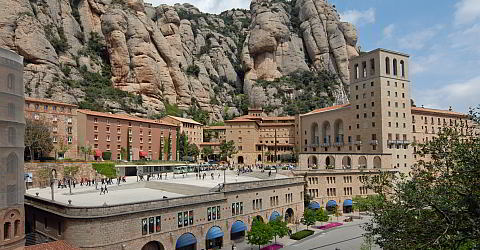
Although I was told several times to plan weekend activities since there is little time to do it during the trip, I found myself on my way to Spain with nothing planned at all.  With help from my classmates, I was able to figure out some day trips to Segovia and Monserrat, but not without stressing out about getting tickets and figuring out the transit the day of the trips.  Buying bus tickets to Segovia was possible the day before you want to go, but I should have looked more into where the bus picks you up as it is difficult to find.  This resulted in me almost missing the bus which would have been disappointing.  My mistake with a day trip to Monserrat was that I did not plan enough time see the sites I wanted to see there.  I left too late in the day and didn’t know that it was an hour train ride to the location.  Because of this lack of preparation, I did not have time to hike to the top of the mountain or go in the monastery which I wanted to see.

Monserrat Monastery

2) Consider Buying a Phone Plan

I decided to not purchase any kind of phone plan for the trip because I did not want to pay for a plan and thought that I could easily get by without one.  I planned on just using messenger to communicate with my friends and family when I had Wi-Fi in the hotel rooms.  Although for the most part I did not need my phone more than with Wi-Fi, there was one function that I really could have had: google maps.  Google Maps is very useful to have because it can help you get to the hotel or find the correct public transit to use.  During the trip I was basically useless with getting anywhere without service, so I always had to be with someone who had it.  If there is a relatively affordable service option available, I would get it for the trip. 

3) Think about Getting Euros Prior to the Day Before the Flight

Travelex Currency Exchange at MSP airport (How I got my Euros)

People who bank with Wells Fargo can go to several locations where the bank will trade currencies on the spot.  However, not all banks provide this service.  I bank with US Bank and they partner with an outside service, Travelex, for all currency exchange.  With Travelex, you get a very bad exchange rate unless you make an online order in advance and pick it up at one of the locations.  This requires you to order 1-5 days in advance to make sure your order goes through. 

The Value of Family Over Work – A look at Hofstede’s Dimensions in Spain, Andy Eichten Blog 4

After learning about the cultural differences of Spain and the US in class, I was curious to see if I would notice differences during our trip. I was surprised at how obvious these differences were to spot.

A Spanish family enjoying a meal together

Hofstede Masculinity vs. Femininity Reflected in Site Visit Discussions

The first Hofstede dimension that I noticed on the trip to Spain was the Masculinity vs. Femininity dimension.  A masculine society shows a preference for achievement and is competitive whereas a feminine society focuses more on quality of life and is less competitive.  At our site visit with Global Healthcare, our speaker Maite Malet discussed how she had experience working both in the United States and Spain.  She mentioned how the Spanish work environment is much more relaxed and less stressful.  There is not a push to constantly improve efficiencies and meet deadlines in the same way that is pushed in the United States.  There are often longer lunch breaks where coworkers get a chance to relax while getting to know each other and discuss business objectives.  This differs from the United States where any action that is not relating to a company’s bottom line seems to be “wasting time” for the company.  Multiple speakers also talked about how in Spain work life is less important than in the United States.  There is a greater emphasis on family time and relationships which aligns with the quality of life characteristic in the femininity dimension.  Lastly, Quadpack speaker David Ackley discussed how US companies are more concerned about competitors in business.  US companies will often spend a lot of time researching what competitors are doing as they are always concerned about staying ahead.  Spain in the US are expected to differ in this dimension with 42 and 62 respectively, but I feel as though there is almost a larger difference than this.  Spain seems much more focused on relationships and quality of life while the US seems very competitive in business. 

A comparison of Spain and the United States using Hofstede’s dimensions
(Spain blue, US purple)

Site Visit Lectures Display Obvious Power Distance Differences

Power distance refers to how much the people in society accept that there are social inequalities.  Often there is a greater hierarchical order present in the workplace.  After experiencing lectures at our site visits in Spain, there are multiple examples of a greater power distance in Spain. At our first site visit at El Corte Ingles, the communications manager gave most of the presentation even though her English was not as proficient as her subordinate.  It would have been more helpful for us students to listen to a presentation with better English, but it seemed that the manager felt obligated to speak more.  Similarly, during our HP lecture, speaker Emili Serra ironically dominated the lecture while explaining how there is not much of a hierarchy in the workplace.  Although maybe it seemed to Ms. Serra that HP had less of a hierarchy in the workplace compared to companies that originated in Spain, it was clear that the positions of the workers in the workplace hierarchy affected their need to speak during lectures. 

HP 3D printing example from our visit

Overall, it was a great experience to witness difference cultural traits in another country. It is important that I learned that not every place is the same as where I am from.

Plaza de Toros Las Ventas – Visiting the World’s Most Significant Bullring

Andy Eichten – Blog 3

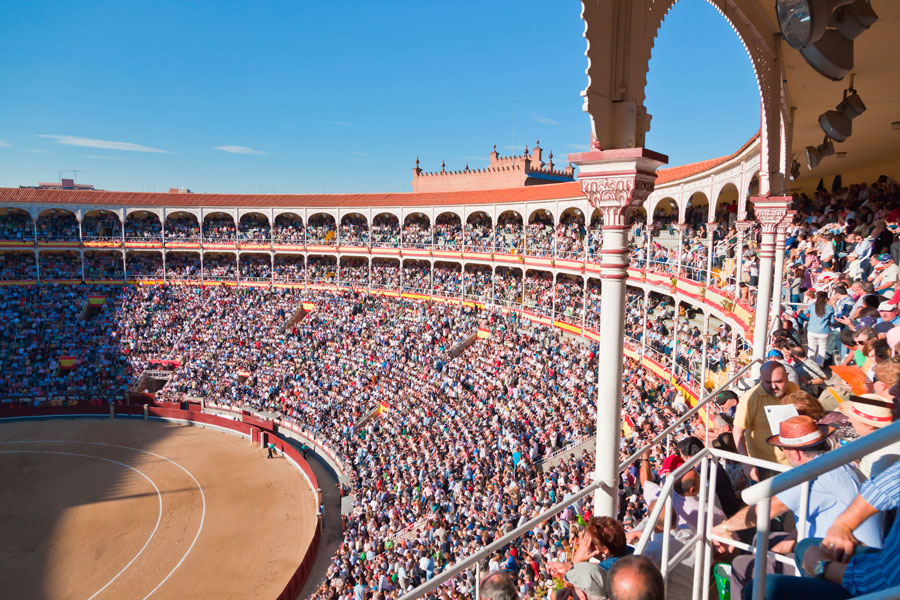
View from the shaded section of Plaza de Toros Las Ventas

I am interested in visiting Plaza de Toros Las Ventas because I would like to see a real live bullfight during our trip to Spain.  Plaza de Toros Las Ventas is considered the home of bullfighting for the entire world, so this is the place to be for witnessing a bullfight.

History of one of Spain’s Most Historic Venues

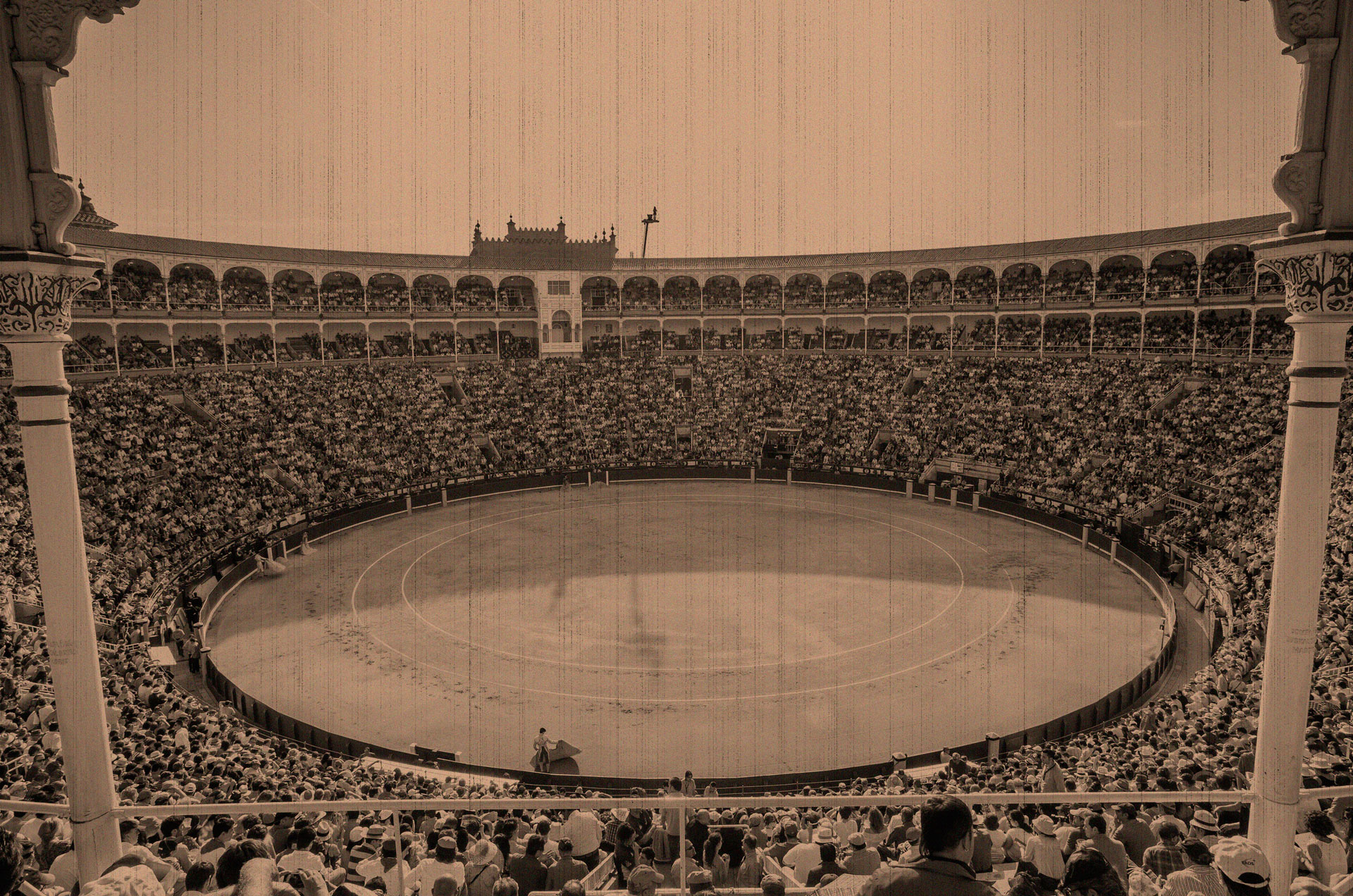
Plaza de Toros Las Ventas was built in 1929 and the first bullfight took place on June 17, 1931.  It is the third largest bullring in the world behind only Mexico City’s Plaza de Toros and Venezuela’s Plaza de Toros Monumental de Valencia.  As the largest bullring in the country, this building holds 25,000 people and is over 60 meters in diameter. 

Inauguration Day June 17, 1931

Explanation of a Tradition Dating Back Thousands of Years

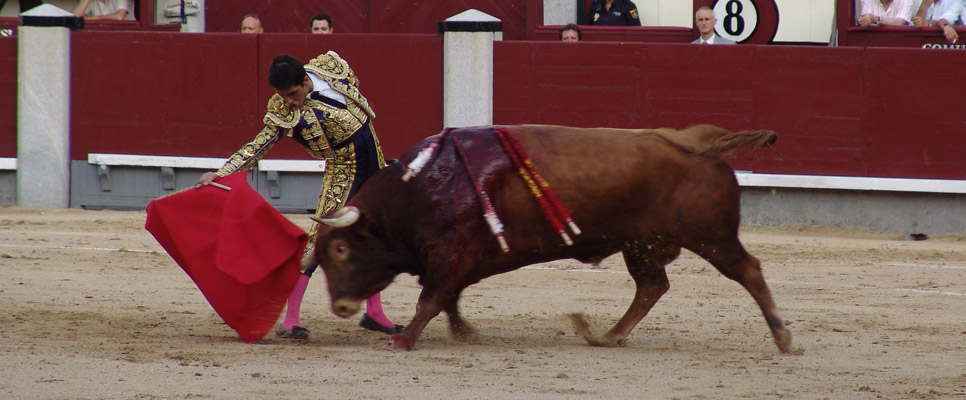
In a standard bullfight (called a corrida) there are six bulls and three matadors.  Each bull encounter typically lasts fifteen minutes which makes an average corrida time of two hours.  The matadors are the stars of the show as they use distinctive maneuvers to avoid the bulls.  The matadors receive higher levels of applause when they allow the bulls close to them while maintaining tranquility.  There are three parts to a bullfight: varas, banderilla, and muerte.  In the first stage called varas (pikes), the matadors greet bulls by allowing them to pass by several times.  Then the picadors, mounted on horses with armor, perform several lancings on the bulls.  In the second stage, the banderilleros work on foot to place banderillas (barbed sticks) into the shoulders of the bulls.  The last stage muerte (death) is the stage that is most exciting for the fans.  Matadors call the faena (“The last act of bullfighting”) where they use their most impressive maneuvers to get as close to the bulls as they can while making it look easy. 

Matador performing a maneuver on a bull

Interesting Facts

  • The bullring was closed during the Spanish Civil War in years 1936-1939
  • Bulls instinctively go for the matador’s cloth because it is a large moving target not because of the red color.  Bulls are actually colorblind.
  • Ivan Fandino, a famous bullfighter, died in 2017 after being gored to death

Attending a Bullfight During our Trip is Easy

While we are in Spain in late May is a great time to see a bullfight because it will be following the San Isidro Fiesta which occurs on May 15.  After this day, there are bullfights almost everyday for three weeks.  Tickets to these events are competitive, but there are still tickets available at multiple price ranges.  The cheapest tickets are usually around 15-20 euros which is very affordable.  These tickets are located in the “sol” section which means it is directly in the sun.  Our hotel is only a seven minute walk from our Madrid hotel!  Simply walk south down Calle Francisco Altimiras and then follow Av. de los Toreros east around the Plaza de Toros complex.  Links to buying tickets or touring the venue are located below along with a map for directions. 

Directions to Plaza de Toros using google maps

Links for more information

Purchasing tickets – https://ticketstoros.com/

Touring information – https://www.las-ventas.com/tour.html

Codorniu: Spain’s Oldest Business and Premier Winery – Andy Eichten Blog 2

Outside the front gates of Codorniu

Codorniu is the oldest business and Spain and still successful today as one of the world’s premier wineries.

A History longer than the United States itself

Codorniu was first established in 1551, making it 468 years old today.  This is 225 years older than the establishment of the United States of America.  According to the company, this is the oldest business in Spain, and the 17th oldest in the world.  Codorniu is located just outside of Barcelona, and is the largest vineyard owner in the all of Europe.  The company owns a total of 3000 hectares which converts to over 7400 acres.  In other terms, this is almost twelve square miles filled with vineyards.  Codorniu prides itself on sustainability, claiming it to be the number one reason for the longevity and success of the company for over eighteen generations.  Currently, Codorniu has just under 200 employees that contribute to a large production output. The four core sustainability factors of the company are to care for the environment, the local development, the people, and the promotion of a healthy life.  Codorniu strives to preserve the environment by employing sustainable agriculture techniques and rationalizing water resources to protect the ecosystems that they rely on. 

Recently harvested grapes from the vineyards

What you get to try during the site visit

Codorniu is famous for producing cava, a Spanish sparkling wine which is similar to champagne.  This main product for the company was first established in 1872, and now is produced at an astonishing rate of over 100,000 bottles per year.  The process starts with a harvest in the months of August and September, a couple of fermentation periods, and finally mixed and sealed to perfection.  Key challenges in this process include harvesting the plots of land at the correct moment of maturation, and keeping the products in the perfect condition to maintain their characteristics.

Final cava product after bottling

European competitors push Codorniu to increase product outreach

Recently, there has been growth of the Spanish cava industry in the United States, but not much in Europe. Codorniu is challenged by European competitors that are producing higher growth products including Italian Prosecco and French Champagne.  Looking forward, Codorniu plans to increase the outreach of their products to by developing marketing campaigns to promote the growth in the cava industry. 

Questions for the site visit?

What are some new products that Codorniu is developing?

Who are Codorniu’s main competitors for cava products?

How has the size of the company changed throughout its history?

What is a current sustainability project that Codorniu is working on?

What are the differences between Spanish cava, Italian Prosecco, and French Champagne?

Andy Eichten – Renewal of Euthanasia Debate in Spain after Video Recording and Arrest

Angel Hernandez interviewing about his decision – New York Times

Angel Hernandez, a 70 year-old man from Madrid, was recently arrested for giving his wife her last wish: “to let her die”.  Along with a video to record this sad event, Mr. Hernandez helped his wife Maria Carasco swallow a euthanasia pill to relieve her of her suffering from multiple sclerosis.  Mr. Hernandez is now facing a possible prison sentence for assisted suicide. As I came across this New York Times article, I was both shocked and intrigued to find out what sparked this event, and how the Spanish government will respond.

Protesters in Madrid showing support for Angel Hernandez – The Telegraph

What caused Angel Hernandez to assist in his wife’s suicide and turn himself in to police?

Maria Carasco, wife to Angel Hernandez was diagnosed with multiple sclerosis over 30 years ago.  This brutal disease has worsened over time to make Ms. Carasco’s life unbearable from pain and inability to move.  She had actually attempted suicide over a decade ago, and had interviewed about her wish to end her life.  Because Ms. Carasco had been open about this wish, she refrained from this action in fear of how her husband would be affected from the laws that forbit this decision.  Recently Mr. Hernandez had had enough.  He could not take to see his wife in this condition, barely able to swallow water.  He decided to record a video of the final moments of her life where he asked whether she was ready to die.  She responded with “The sooner, the better.” Euthanasia, an illegal deadly substance was used in this event. Afterward, Mr. Hernandez turned himself into the police, and is currently awaiting a trial for assisting in suicide. 

Prime Minister Pedro Sanchez

Reaction by the Spanish Government

Current Prime Minister Pedro Sanchez is actually in support of this choice as he describes it as a “dignified death.” Mr. Sanchez said that he would legalize euthanasia if he could get the support from a parliamentary majority.  However, because Sanchez is leader of a Socialist party, he will unlikely not gain support from other parties on this issue.  Also, as Spain is majority Catholic, the opinion of Pope Francis stating in 2017 that euthanasia should not be permitted goes a long way to negate this side of the issue.  This debate relates to Spain’s ratings on Hofstede’s dimensions, specifically Individual vs. collectivism.  A change in this legislation to legalize euthanasia would reflect an individualistic approach as it demonstrates the right for people to make a difficult decision such as this case.  It would allow freedom from the majority religious ideologies in the country, and give more power to individual choice.  Since Spain is near world average on this dimension, it will be interesting to see how they pursue this legislation moving forward.